Ear to the Ground: A Penarth Family Sound Safari for Six Familiar Places
Most learning walks are built around looking: spot the plaque, read the sign, photograph the building. This one is different. It starts with a pencil, a piece of paper and a simple instruction that feels oddly radical in a busy week: stop talking for thirty seconds and listen.
The plan is easy enough for a damp Saturday in November 2026. Choose an afternoon, pick six places you already know, and make a rough family sound map as you go. No tickets, no app, no special equipment. Just ears, curiosity and perhaps a flask in a backpack.
First, Make a Very Unscientific Map
Fold a sheet of A4 into six boxes. Give each box a name: pier, promenade, park, station, library, high street. Draw a wiggly route between them, even if it is not geographically accurate. This is a listening map, not a navigation exam.
Before you set off, agree on a key. You might use symbols for human sounds, natural sounds, mechanical sounds and unexpected sounds. Or rate each spot from one to five for quietness. Or simply write down the one sound each person would choose as that place's signature.
Give everyone a small mission. One person is in charge of high sounds, another low sounds, another repeated sounds. At each stop, stand still for a minute and let the map fill in. The trick is not to hunt for something impressive. The trick is to notice what was already there.
Stop One: Penarth Pier – Echoes and Edges
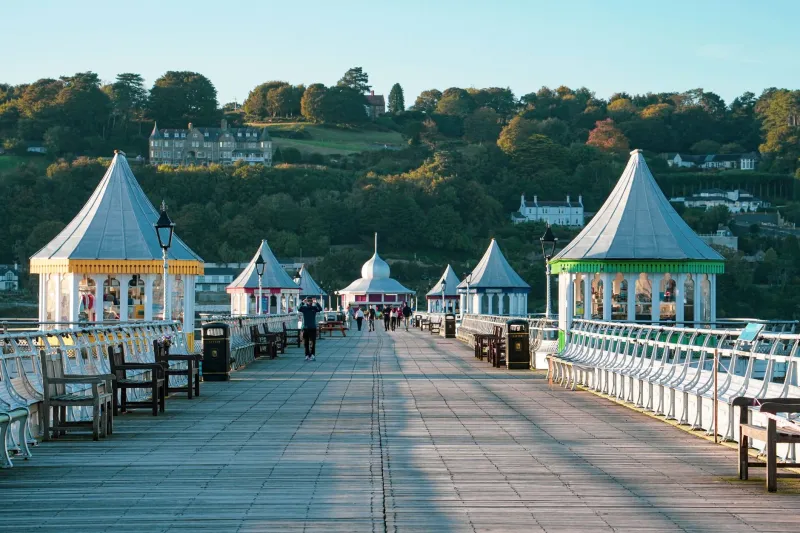
The pier is a natural first stop because it puts you between water and sky, which is exactly where sound behaves in interesting ways. Near the pavilion you may hear footsteps, gull calls, the clink of a café cup, wind tugging at coats. Walk further out and the balance changes.
Ask the family: why does a voice sound different over water? What happens when you stand with your back to the wind? Can you hear an echo, or does the open air swallow it? These are proper science questions dressed up as idle curiosity.
There is local history here too. The pier has been a landmark for generations, a place where people have promenaded, sheltered, queued and looked out to sea. Listening to it now is a small way of joining that long, noisy queue.
Prompt: Close your eyes for thirty seconds. Write down the furthest sound you can hear and the nearest. Compare notes.
Stop Two: The Promenade – Weather You Can Hear
The Esplanade gives you weather with a soundtrack. Wind in railings, waves hitting the sea wall, skateboards, buggies, snippets of conversation, perhaps a dog barking at exactly the wrong moment. It is a good place to notice that sound is always moving.
Try a simple comparison. Stand facing the sea, then turn your back on it. Does the wind sound louder in one direction? Can you hear the difference between water hitting stone and water hitting sand? If it is breezy, ask why it is harder to hear each other. If it is calm, enjoy the rare luxury of a promenade hush.
This is also a wellbeing stop. Instead of asking everyone to be quiet, ask them to listen without judging. You do not have to enjoy every sound. You just have to notice it, name it and let it pass.
Prompt: Make two tally columns: human sounds and natural sounds. Which wins in one minute?
Stop Three: Alexandra Park – Layers of Play
Parks are soundscapes in layers. There is the top layer of playground noise and conversation, the middle layer of birds and rustling leaves, and the low layer of distant traffic or a lawnmower. Ask everyone to listen at three different points: beside a tree, on a bench, near the gate.
Children are often brilliant at this. They hear the squeak of a swing before adults do. Encourage them to describe sounds with comparisons rather than fancy vocabulary: like a rusty hinge, like popcorn, like someone brushing a coat. That is descriptive writing hiding inside a family outing.
For local history, talk about how public parks were designed as breathing spaces for growing towns. For science, talk about habitats and how birds use sound to claim space or call to each other. For wellbeing, simply sit for a minute and let the park do its thing.
Prompt: Choose one sound you would miss if you always rushed through the park. Draw its symbol on the map.
Stop Four: Penarth Railway Station – Timetables and Trains
A station is a lesson in vibration. Stand safely behind the line and listen for the announcement, the door beeps, the rumble before a train appears, the click of the crossing. If you are lucky, you will hear the rails singing before you see anything.
Ask: why can you sometimes feel a train before you hear it? What surfaces make footsteps echo? Why do announcements sound different from a person standing next to you? These are questions about sound waves, materials and distance, but nobody needs to say 'acoustic engineering' out loud.
History sits here too. Railways changed seaside towns, bringing visitors, workers and goods. The station is not just a waiting place; it is a doorway that reshaped local life.
Prompt: Compare platform sounds with street sounds. Which has more echoes? Which has more voices? Write one sentence explaining why.
Stop Five: Penarth Library – The Sound of Concentration
Libraries are not silent. They are quiet in a particular, human way: page turns, keyboard taps, a whispered question, a child's storytime giggle, the shuffle of a chair. Listen for the difference between silence and hush.
This is a good moment to talk about wellbeing and regulation. Some people find quiet calming; others find it unnerving. Ask everyone to rate the library from one to five for 'comfortable quiet'. There is no right answer, which is rather the point.
For science, discuss background noise. What can you still hear when everyone is trying to be quiet? For community learning, notice that a library is one of the few indoor places where you can simply be without buying anything. That is worth teaching by example.
Prompt: Write down three sounds you would normally ignore in a library. Circle the one you like best.
Stop Six: High Street – A Market of Small Sounds
Finish on Windsor Road or the high street, where sound becomes a collage: till beeps, door bells, coffee machines, bus brakes, prams, pigeons, hellos. It is easy to dismiss this as noise. The listening map asks you to treat it as information.
Try a 'three sounds you would miss if you rushed' challenge. Give everyone two minutes to find three small sounds that are not obvious. Compare results. Someone will hear a shopkeeper laughing; someone else will hear a wheelie bin; someone will hear a bus door sigh.
Talk about how high streets change. Shops come and go, but the daily soundtrack of errands, meeting and mooching remains. Listening is a way of taking local history seriously without making it dusty.
Prompt: Pick one high street sound and give it a colour. Add it to the map key.
Back Home: Compare, Draw, Talk
Spread the maps on the kitchen table. Ask three questions. Which sound did everyone hear? Which sound did only one person catch? Which place sounded most like itself?
There is no need to turn this into a worksheet. The learning is in the comparison. Science appears when you talk about echoes, vibration and distance. History appears when you wonder why the pier, station and high street sound the way they do. Wellbeing appears when everyone gets a turn to say what they noticed without being corrected.
A listening map is cheap, adaptable and friendly to different ages and sensory needs. Ear defenders are allowed. Quiet times are allowed. Skipping a stop is allowed. The only rule is to pause long enough to hear something you would otherwise have walked past.
Penarth is full of classrooms without walls. This November, try one that runs on nothing but attention.