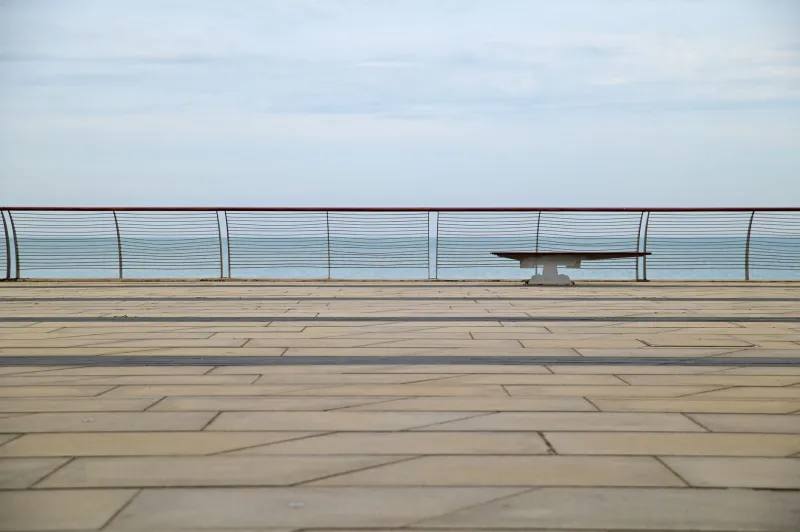
Bench Lessons: Turning Penarth’s Bus-Stop Waits Into Family Learning Time
Photo: Kalispera Dell, CC BY 3.0, via Wikimedia Commons
Penarth has plenty of places to learn: the library, the pier, the rock pools, the promenade. But one of the most overlooked classrooms is the bus stop. Not because it is especially inspiring, but because we spend so much time there. A missed bus, a school run that runs early, a queue at the pharmacy — these small pockets of waiting add up. In 2026, with family schedules as tight as ever, those six minutes are worth noticing.
This is not about turning every pause into a worksheet. It is about a lighter habit: using the time we already have to notice, chat and wonder together. Call it a bench lesson, a shelter challenge, a waiting-room warm-up. The name matters less than the shift in attention.
Why the bus stop is a classroom with no walls
A primary-school teacher in Penarth puts it simply: children learn best when the adults around them are curious out loud. “You do not need a plan,” she says. “You need one question and the willingness to be interested in the answer.” Bus stops are full of questions if you know where to look — patterns in the pavement, numbers on the timetable, the way light moves across a shop window.
The other advantage is brevity. Six minutes is long enough for a mini-lesson and short enough to avoid the glazed-over look. There is no pressure to finish a topic, no need to produce anything, no tidying up. The bus arrives, the lesson ends. That is a feature, not a bug.
Queues and waiting rooms work the same way. A five-minute wait at the dentist, a slow-moving line at the Post Office, the pause before a swimming lesson — all of them can hold a small learning moment. The trick is having a handful of prompts ready so you are not scrambling for ideas when the wait begins.
Start with what is already there
Before any challenge, try one simple move: look down. Penarth’s pavements are a patchwork of slabs, cracks, drain covers and kerb edges. Ask a child to find a pattern — repeating lines, a shape that looks like a letter, a colour that appears three times. This is pattern-spotting, but it feels like a game. Adults can play too. The best waiting lessons are the ones where nobody is being tested.
Local history is another rich seam, and you do not need a book. Why is the road called Stanwell? What might “Penarth” mean in Welsh? Where did the name of the library come from? You do not need to know the answers. A quick search later, or a guess that turns into a conversation, is enough. The wait becomes a hook for curiosity rather than a countdown.
Five no-kit prompts for six-minute waits
-
Pattern detectives. Look at the pavement, the bus shelter, a shop window or the timetable. What repeats? What is the strangest shape you can spot? Can you find three things that are the same colour?
-
The memory tray. Ask everyone to look around for ten seconds and silently choose three things. Look away. Then take turns recalling what you saw. No tray required — the world is the tray.
-
One local-history question. Why does that building have a certain name? What used to be on this corner? Which street has the oldest-looking wall? Let the question hang. If nobody knows, that is the start of the lesson, not the end.
-
Number hunt and estimation. Count the number of people waiting. Estimate how many buses will pass before yours arrives. Add up the house numbers on one side of the road. For older children, work out the difference between the scheduled time and the real time.
-
Story in the shelter. Choose a passer-by or a shop sign and invent a one-sentence story about it. Where are they going? What is in the bag? Why is the sign that colour? Keep it kind and playful. The aim is imagination, not interrogation.
A word of warning from the same Penarth teacher: stop while it is still fun. “If a child is done, let it go,” she says. “The point is to build a habit of noticing, not to squeeze learning out of every second.”
A 2026 family challenge for Penarth
Between now and the end of term, try a low-stakes Six-Minute Winter Wait Challenge. Pick one wait a week — the school bus, a Saturday queue, the pause before an appointment — and choose one prompt from the list. No scoring, no stickers, no certificates. Just a conversation.
You could keep it even simpler: each family member brings one question to the bus stop. It might be about the town, the sky, the timetable or the person in front of you in the queue. The only rule is that the question has to be answerable by looking, guessing or chatting. Then let the bus arrive and the lesson end.
Penarth is a town built on small distances — from the pier to the library, from Windsor Road to the Esplanade, from one bus stop to the next. Learning here does not have to be a big day out. Sometimes it is a six-minute wait, a bench, and someone willing to say, “Look at that. What do you reckon?”
Next time the bus is late, it is not wasted time. It is a tiny classroom with no walls, no register and no homework. And it is already on your timetable.