Chasing Drains and Ripples: A Penarth Family's Rainy-Day Field Notes
Photo: Romanov family or retinue, Public domain, via Wikimedia Commons
Rain in Penarth rarely arrives politely. It comes sideways off the Bristol Channel, rattles the windows of the Pier Cafe, and turns the walk from the Esplanade to Alexandra Park into a series of small, reflective lakes. Most of us treat those lakes as obstacles. A family field trip treats them as exhibits. The idea isn't to drag children out in a downpour for a lecture on hydrology. It's to notice that a wet afternoon already contains a science lesson, a map-reading exercise and a bit of local history, all free at the point of use.
Start at the kerb, not the classroom
Pick a short route: one street, one park, one stretch of promenade. Begin at the nearest kerb. Ask a simple question: where did this puddle come from? Not philosophically. Practically. Watch the gutter. Look for the grate. Follow the slope with your eyes. Water obeys gravity, and gravity is easy to spot once you're looking for it.
A useful prompt: 'If this puddle could talk, what would it complain about?' Children often answer with surprising precision. Leaves blocking a drain. A car parked on the camber. A dropped crisp packet forming a tiny dam. That's engineering, disguised as moaning.
What a puddle is actually telling you
A puddle is a story about surfaces. On tarmac, water spreads and sits because the surface is impermeable. On grass, it vanishes more quickly because soil and roots make room. On a sloping pavement, it runs. On a flat one, it pools. Give each family member a job: one spotter, one sketcher, one measurer. A cheap plastic ruler or a stick marked in centimetres is enough. Record the widest point, the deepest point, and the shape. Is it a long thin puddle or a round one? Does the wind push ripples to one side?
Reflection is the other easy win. Ask everyone to look at what appears upside down in the water. A lamp post. A cloud. A seagull. Then ask why the reflection bends when the wind disturbs the surface. You don't need the word 'refraction' to have the conversation. You just need to notice that still water is a mirror and moving water is a puzzle.
The drain-spotting detour
Drains are the unsung heroes of a wet walk. In Penarth, as in most UK towns, the gullies and gratings are a visible part of a hidden system. Some lead to soakaways, some to surface-water sewers, some simply to the sea via outfalls. You don't need to know which is which to ask good questions. Where does this one go? Why is it here and not there? What would happen if it were blocked?
This is also where map-reading sneaks in. A phone map or a folded Ordnance Survey sheet can show you the shape of the streets and the lie of the land. Look for contour lines, even gentle ones. Find the high point of your route and the low point. Then predict where the water will gather. Test the prediction. Being wrong is part of the fun, and it's a better lesson than being told.
A short history of wet Penarth
Penarth grew as a seaside town, and its streets and promenade were laid out in an era before anyone talked about sustainable drainage. The Victorian and Edwardian builders thought about views, sea air and respectable strolls. They thought less about permeable paving and rain gardens. That's not a criticism; it's a clue. When you see water pooling at a junction, you're seeing the meeting point of old street design and modern weather.
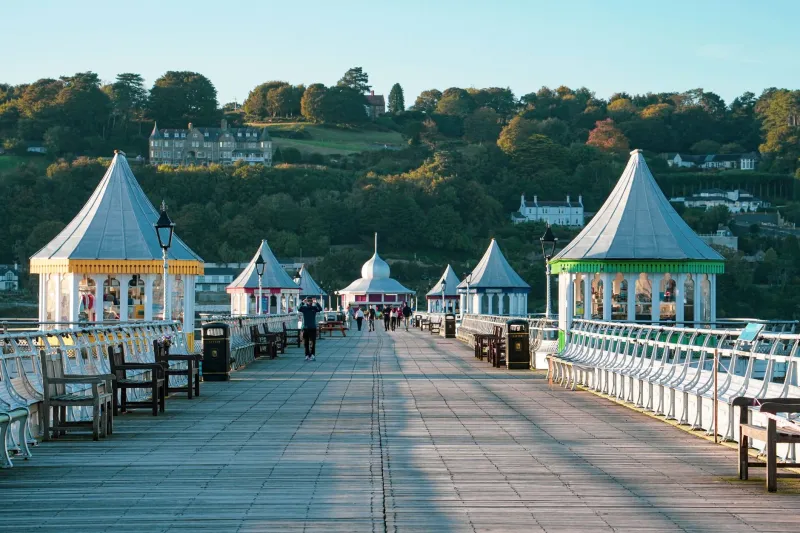
The pier and the Esplanade tell a similar story. The sea has always been Penarth's draw and its problem. Storms rearrange shingle. Rain runs off roofs and roads. The town has spent generations learning how to live with water rather than against it. A family walk can notice that without needing a textbook. Look at the sea defences, the raised kerbs, the drains set into the promenade. Ask what they're for. Then ask who decided.
Sketch, measure, ask
Bring a small notebook and a pencil. Sketching forces looking. It doesn't matter if the drawing is good. Draw the puddle's outline. Mark the drain. Add an arrow for the slope. Write one question you can't answer. That question is the real souvenir.
Three prompts to carry:
- 'What is the smallest puddle on this street, and why is it smaller?'
- 'Where does the water go after the drain, and how could we find out?'
- 'What would this place look like if the rain stopped for a week?'
The promenade finale
Finish where the water meets the sea. The promenade is a good place to compare scales: a puddle, a gutter, a harbour, a channel. Ask everyone to guess how long a raindrop takes to travel from the pavement to the sea. Then admit nobody knows for certain, because the route is full of bends, drains and delays. That's the point. Water is a traveller with a complicated itinerary.
If the rain has stopped, look for the last puddles and the first reflections. If it hasn't, embrace the wet. Wellies are optional but liberating. A flask of something hot is not optional at all.
What to take (and what to leave behind)
Take: waterproof coats, a pencil, a small ruler, a phone or map, a flask, and one adult willing to crouch at a drain. Leave behind: the idea that a wet afternoon is wasted. Penarth's puddles are not interruptions to the day. They're the day's most reliable teachers. All you have to do is follow the water.